
• Link to Facebook Link to Facebook Link to Facebook
  • Link to Instagram Link to Instagram Link to Instagram
  • Italiano Italiano Italian it
  • English English English en
  • Deutsch Deutsch German de
info@albergospina.it I T: +39 0428 820209
  • Hotel
  • ROOMS
  • Services
  • Special
  • EVENTS
    • Surroundings
    • Sports and activities
  • CONTACTS
  • Click to open the search input field Click to open the search input field Search
  • Menu Menu

Krampus

in Events and news

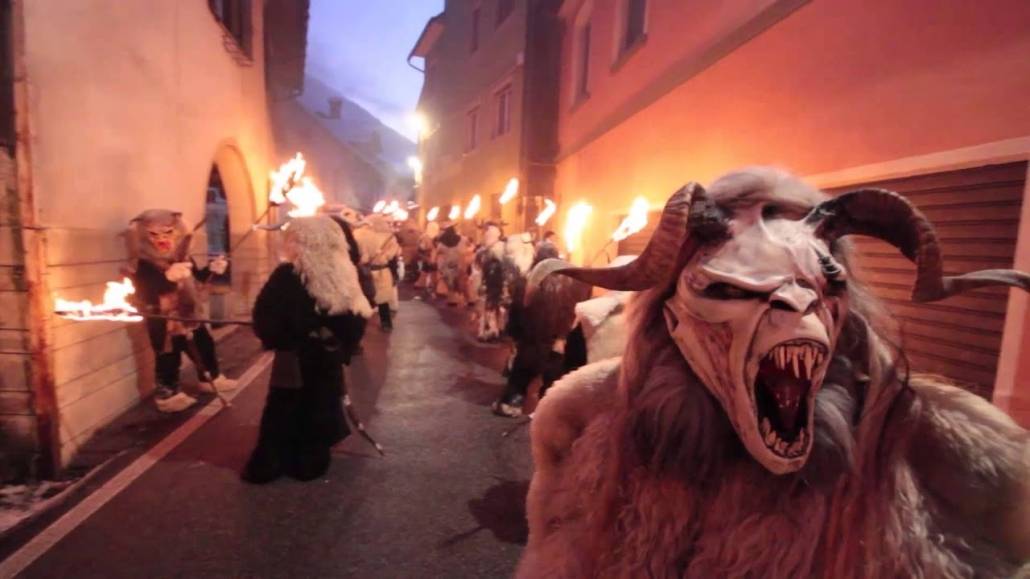
The Krampusare today linked to the tradition of San Nicolò, which is traditionally celebrated on the evening of December 5th. The ritual, typical of several countries in the Alps (Sudtirol, Friuli, Austria, Switzerland but also Germany, Hungary and the Czech Republic), is centered on the parade through the streets of the town ofSan Nicolò. In Friuli, the tradition is widespread in the Val Canale: in the area of Tarvisiano, Ugovizza, Malborghetto and Pontebba.

San Nicolò, with a thick white beard, accompanied by angels, distributes sweets to the little ones and the good ones. Angry devils follow him: the krampus in search of evil children. As soon as the sun sets, San Nicolò disappears leaving the population at the mercy of the devils, who chasing people everywhere.

he Krampus have scary masks; their clothes are worn and dirty. As they wander through the night they make grim noises, made by cowbells or horns. There are also “female” Krampus (the Krampas) also, however, personified by men. There are several rules to be followed in order to become part of a “Krampus Group”, among the main ones, that of never taking off your mask in public. There are several legends about the birth of this tradition. The Friulian rite takes place on the first Sunday of December after the 5th, in Pontebba. Mentre vagano nella notte provocano tetri rumori, ottenuti da campanacci o corni. Esistono anche dei Krampus “femmina” (i Krampa) anch’essi, però, impersonati da uomini. Sono diverse le regole a cui sottostare per entrare a far parte di un “Gruppo Krampus”, tra le principali, quella di non togliersi mai la maschera in pubblico.

Diverse sono le leggende sulla nascita di questa tradizione.

Una di queste narra che in periodo di carestia, ragazzi dei villaggi di montagna dopo essersi travestiti, e resi irriconoscibili, usando pelli e corna di animali, terrorizzavano gli abitanti dei paesi vicini, derubandoli delle provviste necessarie per l’inverno. Ben presto, però, i ragazzi si accorsero che tra loro c’era un impostore: era il diavolo in persona, che approfittando del suo volto terrificante si era introdotto nel gruppo rimanendo riconoscibile solo dai piedi a forma di zoccolo di capra. Venne, allora, chiamato un vescovo, Nicola, per esorcizzare la terribile presenza. Da allora, sconfitto il Demonio, i ragazzi mascherati da diavolo continuarono a recarsi nei villaggi vicini, non più a depredare ma a portare doni accompagnati dalla figura del Vescovo, cioè colui che aveva sconfitto il male.

Il rito friulano ha luogo la prima Domenica di dicembre dopo il 5 a Pontebba.

Share this entry
  • Facebook Facebook Share on Facebook
  • Square-x-twitter Square-x-twitter Share on X
  • Whatsapp Whatsapp Share on WhatsApp
  • Linkedin Linkedin Share on LinkedIn
  • Mail Mail Share by Mail
https://www.albergospina.it/wp-content/uploads/sites/36/2021/08/image-8.jpeg 720 1280 ghotels https://www.albergospina.it/wp-content/uploads/sites/36/2021/04/albergo_spina_logo.svg ghotels2021-08-24 16:40:092021-08-24 16:45:10Krampus
  • Monte Lussari

    The easternmost peaks of the Alps have been the natural border between the Latin, German and Slav worlds since time immemorial. Today, in a time of peace, they still speak the languages of these peoples and their valleys are places of friendship and cooperation. Attracting pilgrimsfrom three lands, the shrine of Monte Lussari, in the northeastern corner of Italy, is truly European and a symbol of this peaceful coexistence. According to ancient folklore, the sanctuary has its origins in 1360following a series of miraculous events: a shepherd found sheep from his flock kneeling around a bush. With amazement, he realised that a statuette of the Virgin and Child was at the centre of the bush. The shepherd gave it to the priest of Camporosso, but the following morning, the statue was found on Lussari with the kneeling sheep surrounding it again. The event repeated itself a third time. Having been informed, the Patriarch of Aquileia ordered that a chapel be built on the spot. There is no trace left of the original chapel; the current building is the result of the restoration and extension of a 16th Century building. The sanctuary is accessible by foot via the picturesque Sentiero del Pellegrino (Pilgrim’s Path) that winds through the forest of Tarvisio, or with the cable car from Camporosso. Mount Lussari is also famous among ski lovers for its exciting Di Prampero ski run that offers one of themost exciting descents in the region, while the Sentiero del Pellegrino is highly appreciated by trekking lovers. Ogni anno a marzo si svolge sulla pista il Lussarissimo: gara che allo sci alpino (slalom gigante parallelo più lungo del mondo) abbina anche le ciaspole (Ciaspolissima) e lo scialpinismo, con la gara vertical notturna Down Up.

  • Tarvisio

    Tarvisiois located on the edge of the homonymous forest, 30 km away from Pontebba, on the border with Austria and is an excellent destination for a half-day or full-day trip In addition to the lively city full of shops, bars and restaurants, you can find ski slopes for the whole family. The ski area includes 33 km of blue, red and black classified slopes with artificial snow and it is possible to sky by night on the “Di Prampero” slope (which descends from Mount Lussari). There are many circuits for everybody with varying degrees of difficulty. Even lovers of Nordic skiing will be satisfied, there are 60 km of trails, including the Arena dedicated to the Olympic champion Gabriella Paruzzi, used for international competitions. In Tarvisio, in addition to typically winter sports, you can enjoy trekking, walking in nature but it is also possible to Golf, as the “Golf Club Senza Confini” hosts a well-kept 18-hole course framed by the Millennial Forest. You will be surranded by the stunning Alpin flora and fauna.

  • Forest Sound Track

    The precious wood of the local picea abies (spruce) is especially fit for manufacturing stringed instruments. The precious wood of the local picea abies (spruce) is especially fit for manufacturing stringed instruments. This is 5.5 km trail (and the same for the way back) that leads to the slopes of Mount Nabois Piccolo, in a wonderful spruce wood. The trail has several access points. To walk it all, you have to start from the heart of Valbruna, near the Saisera Hotel. For a shorter trip, you can start from Saisera Hütte (where you will also find a parking place), Agriturismo Prati Oitzinger or Locanda Montasio. The trail is accurately signposted, including panels that describe the peculiar resonance properties of spruce wood and the complex art of making stringed instruments. Ideal for half day excursions.

  • Pontebba
    Albergo Spina Pontebba

    Pontebba, located on the Tarvisian mountain area is animportant center of the Valcanale, the last valley of Friuli-Venezia Giulia before the Austrian and Slovenian border. The border between Italy and Austria, until the First World War, passed through Pontebba: the ancient denominations of Venetian Pontebba, to indicate the Italian part and Pontafel to indicate the Carinthian part can still be read on the old maps. The city center is rich of historical sites: the Town Hall, which was built in 1923 by the architect Provino Valle; The Parish Church of Santa Maria Maggiore has a wonderful wooden altar with doors, the Flügelaltar of 1517, with carved parts, painted with sacred and gilded scenes, and it’s considered the jewel of the Church and has been declared a national monument. Ice skating lovers can have fun at the Palaghiaccio Claudio Vuerich, located right in the center of Pontebba! Cross-country skiing enthusiasts have access to the AUPA track. The climbing wall at the Rio degli Uccelli and the children’s playground complete the sporting and recreational offer. From Pontebba, you can go trekkingand discover enchanted mountain valleys. In winter, the ski resorts of Tarvisiano and the Pramollo-Nassfeld ski area can be reached in a short time.

  • Theme park and museum of the First World War
    museo della grande guerra di Pontebba

    The association “Quello che le Montagne Restituiscono” manages the homonymous museum of the First World War at the municipal headquarters in Piazza Garibaldi. Whiere thousands of artifacts found in the mountains of Friuli are exposed. The museum of the First World War of Pontebba is constantly updated and houses very important military items of daily life of the soldiers at the front. The association is responsible for organizing guided tours for tourists and takes care of the “Bombaschgraben” theme park of the Great War. The route highlights what remains of the outpost line and the first defensive line built by the Austro-Hungarian troops during the First World War.

G-HOTELS S.r.l. - piazzale Cella, 50 33100 Udine C.F., P.IVA 02635920305 - n. REA di Udine UD276303; cap.soc. € 10.000 i.v. - Informativa privacy e cookies - Trasparenza - Lavora con noi - Codice CIN IT030076A1ZZ4QBHGF
  • Link to Facebook Link to Facebook Link to Facebook
  • Link to Instagram Link to Instagram Link to Instagram
Link to: Sentieri Link to: Sentieri Sentieri Link to: Opening 2023 Link to: Opening 2023 Apertura Albergo Spina PontebbaOpening 2023
Scroll to top Scroll to top Scroll to top